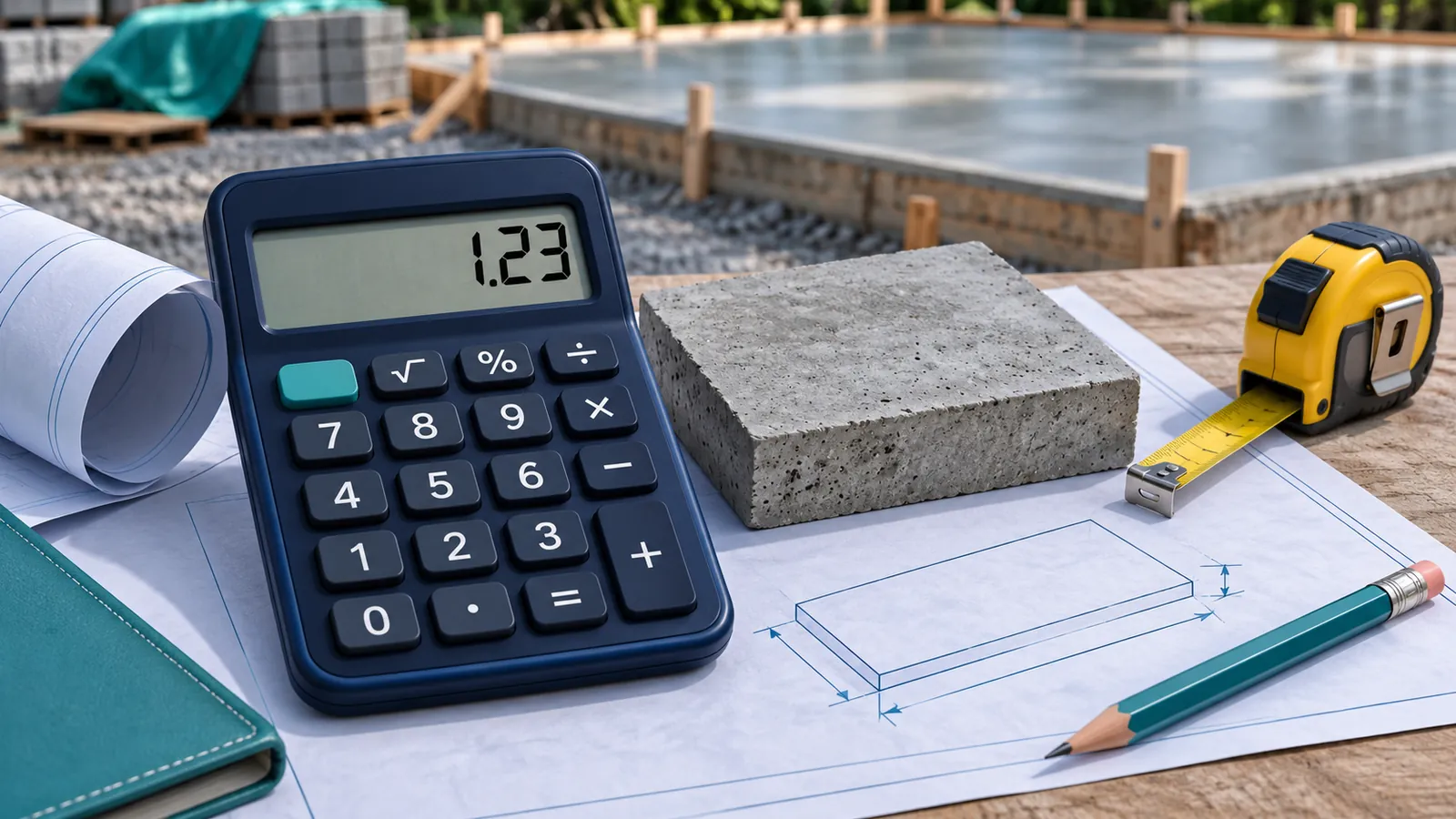
To find how much concrete you need, multiply length by width by thickness in matching units, then convert the volume to cubic yards if ordering in the United States. A 10 ft × 10 ft slab, 4 inches thick, needs 1.23 cubic yards before waste. Project shape, uneven ground and your chosen material allowance also affect the final order.
Measure first, then use the CalcVibes Concrete Calculator for a faster estimate. The formulas, yardage chart and bag examples below help you understand the result and discuss the quantity with your supplier.
How to Calculate How Much Concrete You Need
Concrete is measured by volume, not just surface area. Measure inside the forms, record the planned concrete depth, and sketch the shape. Split an irregular outline into rectangles or circles you can calculate separately. Keep gravel, topsoil removal and concrete quantities on separate lines.
Concrete volume formula
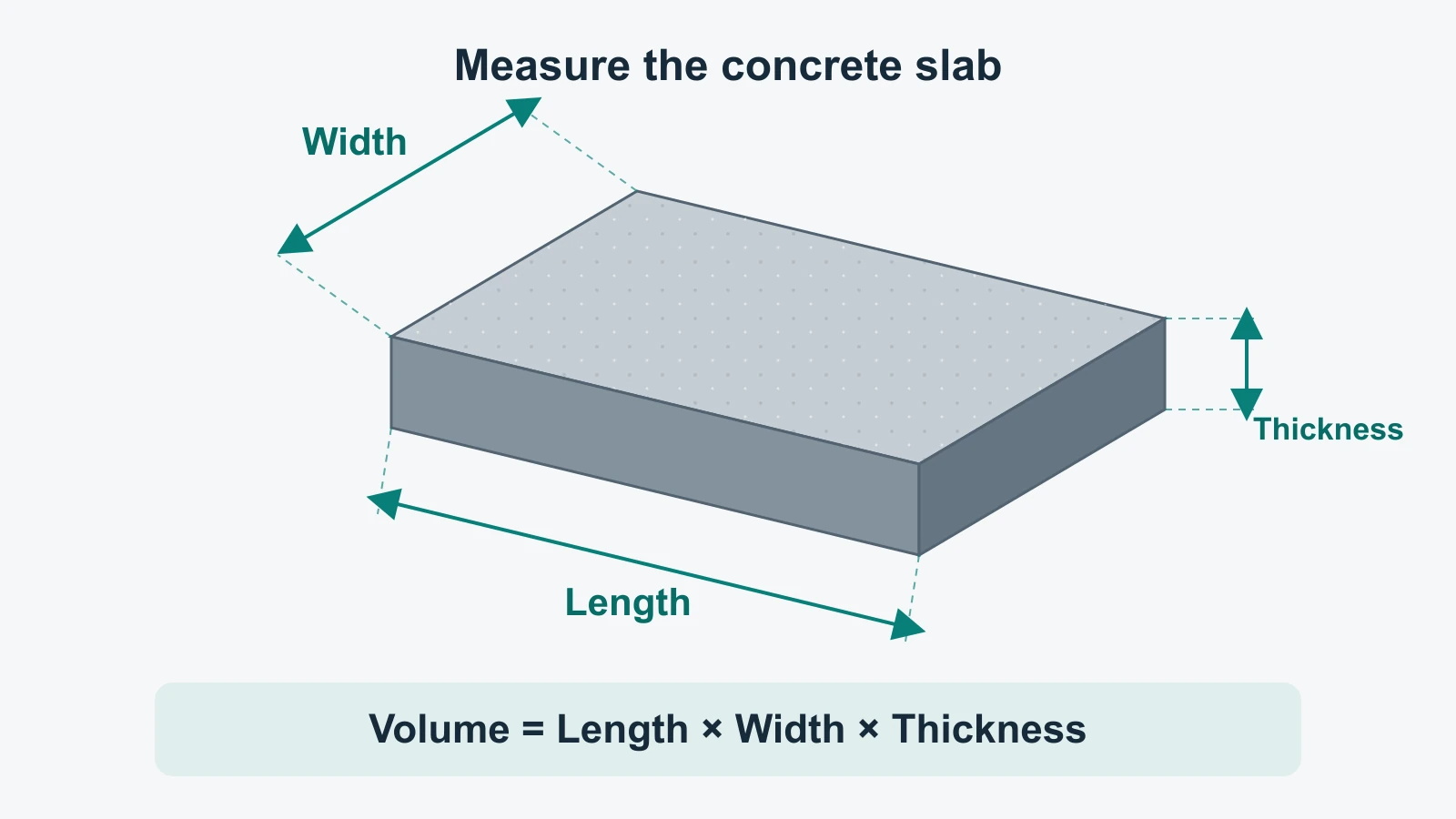
For a rectangular slab, use one of these equivalent formulas:
- Cubic feet = Length (ft) × Width (ft) × Thickness (ft).
- Cubic yards = Cubic feet ÷ 27.
- Cubic yards = Length (ft) × Width (ft) × Thickness (in) ÷ 324.
The last formula combines 12 inches per foot with 27 cubic feet per cubic yard: 12 × 27 = 324. It works only when length and width are in feet and thickness is in inches. Writing the unit next to every measurement prevents expensive mistakes.
For metric measurements, Cubic meters = Length (m) × Width (m) × Thickness (m). Divide millimeters by 1,000 or centimeters by 100 before multiplying. For example, 3 m × 3 m × 0.1 m = 0.90 m³. One cubic yard is approximately 0.7646 m³; one cubic meter is approximately 1.3080 yd³.
Step-by-step concrete calculation example
For a 10 × 10 ft slab with a specified 4-inch concrete thickness:
- Calculate area: 10 × 10 = 100 square feet.
- Convert thickness: 4 ÷ 12 = 0.3333… feet.
- Multiply: 100 × (4 ÷ 12) = 33.33 cubic feet.
- Convert: (100 ÷ 3) ÷ 27 = 1.2346 cubic yards.
- If a 10% allowance is appropriate, multiply by 1.10: approximately 1.36 cubic yards.
Keep full precision through the calculation and round the displayed answer at the end. The 10% allowance is a planning example, not a universal requirement. Enter these measurements in the concrete volume calculator to compare the base volume, allowance and bag estimates.
Concrete Yardage Chart for Common Slab Sizes
This concrete slab reference chart uses the same formula for every row. Volumes are rounded to two decimals and exclude waste, thickened edges and supplier rounding. On smaller screens, scroll the table sideways to compare both depths.
| Slab dimensions (ft) | Area (sq ft) | 4-inch thickness (yd³) | 6-inch thickness (yd³) |
|---|---|---|---|
| 8 × 8 | 64 | 0.79 | 1.19 |
| 10 × 10 | 100 | 1.23 | 1.85 |
| 10 × 12 | 120 | 1.48 | 2.22 |
| 12 × 12 | 144 | 1.78 | 2.67 |
| 10 × 20 | 200 | 2.47 | 3.70 |
| 12 × 20 | 240 | 2.96 | 4.44 |
| 20 × 20 | 400 | 4.94 | 7.41 |
| 20 × 30 | 600 | 7.41 | 11.11 |
At 4 inches thick, a 10 × 20 ft slab needs 2.47 yd³, a 12 × 12 ft slab needs 1.78 yd³, and a 20 × 20 ft slab needs 4.94 yd³. Changing from 4 to 6 inches increases volume by 50%, so thickness deserves as much attention as the footprint.
For a different footprint, the Square Footage Calculator can help establish area. Then multiply that area by concrete thickness in feet and divide by 27.
How Many Bags of Concrete Do I Need?
Bag counts depend on the dry mix’s labeled finished yield, not simply its weight. Concrete mix includes cement and aggregates; a bag of cement alone is a different product. Check the exact product, package size and mixing instructions before estimating.
Number of bags = Required cubic feet ÷ Yield per bag. Always round up to whole bags after including any chosen allowance.
QUIKRETE Concrete Mix No. 1101’s product sheet lists approximate yields of 0.30 ft³ for 40 lb, 0.45 ft³ for 60 lb and 0.60 ft³ for 80 lb bags. The following estimates use those specific yields; other mixes may differ.
| Bag size | Yield per bag (ft³) | Slab: no waste | Slab: 10% allowance | One yd³: no waste |
|---|---|---|---|---|
| 40 lb | 0.30 | 112 | 123 | 90 |
| 60 lb | 0.45 | 75 | 82 | 60 |
| 80 lb | 0.60 | 56 | 62 | 45 |
Using the slab’s unrounded 33.3333… ft³, the no-waste estimates are 112 forty-pound bags, 75 sixty-pound bags or 56 eighty-pound bags. For one cubic yard, the same yields give 90, 60 or 45 bags, respectively. These are planning quantities based on approximate product yields.
Bagged concrete is mixed on site in batches. Ready-mix arrives already mixed, usually by truck, and is ordered by volume. Compare transport, mixer access, available helpers and placement time as well as material prices. A large bag count can require substantial handling even when the slab looks small.
Follow the manufacturer’s water instructions rather than adding water to stretch the mix. OSHA’s concrete hazard guidance explains that wet cement can burn skin. Use suitable gloves, boots and eye protection, and follow product guidance for controlling dust when opening and mixing bags.
Concrete Cost Per Cubic Yard
A cubic-yard price is only one part of a concrete project budget. Specify the mix and quantity when asking local suppliers for an itemized quote; regional conditions, delivery distance and order size affect what you pay. This guide does not present a current national average.
Estimated material cost = Cubic yards × Price per cubic yard.
Hypothetical example: at an assumed $175 per cubic yard, 1.36 yd³ × $175 = $238 for concrete material, before delivery, labor, taxes and additional fees. This example prices the rounded 1.36 yd³; it is not a supplier quote or market average.
- Delivery and short-load charges: ask about delivery zones, minimum loads, waiting time and small-order fees.
- Pumping or other placement equipment: access may require separate equipment and labor.
- Reinforcement and formwork: include the specified steel or mesh, chairs and forms.
- Site preparation: excavation, disposal, base materials and compaction are separate costs.
- Labor and finishing: placing, screeding, jointing, surface finishes and curing affect the installed price.
Actual supplier minimums and ordering increments may differ from a calculated 1.36 yd³. Ask what quantity will be billed and which charges are included. For bags versus ready-mix, compare complete quotes for the same project, rather than a bag price against an installed square-foot price.
How Thick Should a Concrete Slab Be?
Choose thickness for the project’s design before calculating quantity. The 4- and 6-inch chart columns are useful estimating scenarios, not approval that either depth suits your site.
For patios and pedestrian sidewalks, QUIKRETE’s slab example uses 4 inches of concrete over a separate gravel base. That example does not establish a universal specification. Shed slabs also need consideration of equipment, wall loads, anchors and the shed manufacturer’s foundation requirements.
Driveways and garage floors carry vehicle loads and may need a different design from a walking surface. For heavier vehicles, lifts or concentrated loads, have a qualified professional determine the slab and support requirements rather than selecting a thicker number by guesswork.
Soil bearing conditions, drainage, reinforcement, frost exposure, intended loads and local codes all matter. Reinforcement does not automatically make an undersized slab suitable. The actual finished thickness also depends on the prepared base: a nominal 2 × 4 form is about 3½ inches deep, as QUIKRETE’s thickness FAQ notes. Measure the planned concrete section itself.
Calculating Concrete for Different Projects
Concrete patios
Use length × width × thickness for a rectangular patio. For an L shape, calculate two non-overlapping rectangles and add their volumes. Measure the slab, not surrounding landscaping. A 12 × 12 ft patio at an assumed 4 inches needs 1.78 yd³ before allowance; a specified thickened perimeter adds volume separately.
Driveways
Divide the driveway into sections with their actual widths and specified depths, including any apron. A 20 × 30 ft rectangle at an assumed 6 inches needs 11.11 yd³ before allowance. Do not treat that example as a thickness recommendation. Check slopes, edge details, drainage and access with the installer.
Sidewalks
For a straight walk, multiply the total length by clear width and concrete thickness. A 3 × 40 ft walk at 4 inches needs 40 ft³, or 1.48 yd³ before allowance. Separate steps, landings and changes in depth into additional calculations instead of stretching one average measurement.
Footings
For a rectangular strip footing, Volume = Total length × Footing width × Footing depth, with every dimension in feet for cubic feet. For example, 40 ft × 2 ft × 1 ft = 80 ft³, or 2.96 yd³ before allowance. Avoid counting intersecting corners twice.
Complex foundations can require separate calculations for strips, pads, walls and thickened edges. If a slab calculation already includes the slab thickness above a footing, add only the extra footing depth there. Structural sizes, reinforcement and frost requirements need professional review using the project drawings.
Circular slabs
Use Volume = π × radius² × thickness. Radius is half the diameter. For a 10 ft diameter circle at 4 inches, π × 5² × (4 ÷ 12) = 26.18 ft³, or approximately 0.97 yd³ before allowance. Using diameter in place of radius makes the result four times too large.
Concrete posts and cylindrical holes
Use Volume = π × radius² × depth for a solid cylindrical column or empty round hole. A 12-inch diameter hole with 3 ft of concrete depth holds π × 0.5² × 3 = 2.36 ft³ before allowance. Multiply by the number of identical holes.
For a hole containing a post, subtract the volume of the embedded post only over the depth it occupies within the concrete. Exclude any gravel layer from concrete depth. Check footing dimensions and post installation requirements separately; the volume formula does not determine a safe foundation.
How Much Extra Concrete Should You Order?
A perfect geometric volume assumes the forms and excavation match your measurements. Uneven excavation, subgrade variations, spillage, formwork tolerances and measurement errors can increase actual demand. Recheck obvious low spots and form movement before compensating with extra concrete.
An illustrative 5–10% planning range may be useful for discussing a reasonably measured project with the supplier or installer. It is not a guaranteed rule. Site uncertainty and supplier requirements can justify a different quantity; a percentage cannot fix an inaccurate survey.
Planned volume = Calculated volume × (1 + Allowance percentage ÷ 100). The 10 × 10 ft example becomes about 1.30 yd³ at 5% or 1.36 yd³ at 10%. For bagged mix, apply the allowance to cubic feet first, then divide by bag yield and round up.
NRMCA’s ready-mix ordering guidance discusses quantity and coordination with the producer. Agree on the order size, delivery schedule, placement method and any permitted on-site adjustments. Arrange how surplus concrete will be handled before the truck arrives.
Common Concrete Calculation Mistakes
- Confusing inches and feet. Divide inches by 12 when calculating cubic feet, or use the combined ÷ 324 formula with feet, feet and inches.
- Forgetting cubic feet to cubic yards. Divide by 27, not 3. Write ft³ or yd³ beside each answer.
- Measuring thickness incorrectly. Measure from the prepared base to the intended top surface, excluding gravel. Check depth in several places.
- Ignoring irregular shapes. Sketch separate sections and add their volumes. Subtract genuine openings and avoid overlapping areas.
- Forgetting supplier minimums. Confirm billing quantities, order increments and short-load charges before treating calculated volume as the order.
- Underestimating uneven ground. Regrade where needed and measure variations. A deeper patch consumes more concrete even if the surface area is unchanged.
- Confusing dry mix weight with finished volume. Use the specific bag’s yield. Do not substitute cement-only bags or estimate finished cubic feet from pounds alone.
Frequently Asked Questions
How much concrete do I need for a 10x10 slab?
A 10 × 10 ft slab at 4 inches needs 33.33 ft³, or 1.23 yd³ before waste. With an illustrative 10% allowance, plan around 1.36 yd³ before supplier rounding. At 6 inches, its base volume is 1.85 yd³.
How many yards of concrete are in a 10x20 slab?
At 4 inches thick, a 10 × 20 ft slab needs 2.47 yd³. At 6 inches, it needs 3.70 yd³. Both exclude allowance and additional edge or footing volume.
How many 80 lb bags of concrete make one cubic yard?
Using a labeled yield of 0.60 ft³ per bag, 27 ÷ 0.60 = 45 bags before waste. Verify your product’s yield; an 80 lb label alone does not establish finished volume.
How many 60 lb bags of concrete make one cubic yard?
At a labeled yield of 0.45 ft³ per bag, one cubic yard takes 27 ÷ 0.45 = 60 bags before waste. Include your chosen allowance before rounding up.
How do I calculate concrete in cubic yards?
Multiply length and width in feet by thickness in inches, then divide by 324. Alternatively, multiply all three dimensions in feet and divide by 27. Use the appropriate shape formula for circular projects.
How much concrete do I need for a driveway?
Calculate each section’s area and multiply by its specified thickness. A 20 × 20 ft driveway at an assumed 6 inches needs 7.41 yd³ before allowance. A professional should confirm the depth and design for your loads and soil.
How much does one cubic yard of concrete cost?
Ask local suppliers for a quote for your mix, quantity and delivery address. At this guide’s hypothetical $175 per yard, one yard’s material cost is $175 before other charges; this is not a current average or an installed price.
Should I order extra concrete?
Discuss an allowance for measurement uncertainty, uneven ground and placement losses with your installer and supplier. The illustrative 5–10% range is a planning aid, not a requirement or guarantee of sufficiency.
How many square feet does a yard of concrete cover?
One yard contains 27 ft³, so coverage is 324 ÷ thickness in inches. It covers 81 sq ft at 4 inches or 54 sq ft at 6 inches, before waste, thickened sections and uneven ground.
Is it cheaper to use concrete bags or ready-mix?
It depends on local prices and project size. Compare the rounded bag count plus transport, mixing equipment and labor against a ready-mix quote including delivery, minimums, placement and waiting charges. Neither option is always cheaper.
Related Calculators
Browse the Construction & Home calculators for related measuring tools. The existing Concrete Calculator already supports slab and bag estimates, volume conversions and optional material costs; separate specialist tools are listed below only when available.
- Concrete Calculator
Estimate slab, footing and cylindrical volumes, bags and optional material costs.
- Square Footage Calculator
Work out the surface area before multiplying by thickness.
- Gravel Calculator
Estimate a separate gravel base using its own dimensions.
- CM to Inches Converter
Convert centimeter measurements before using an imperial formula.
- MM to Inches Converter
Check slab dimensions given in millimeters.
Concrete Bag CalculatorComing Soon
A dedicated bag-quantity tool.
Concrete Slab CalculatorComing Soon
A separate slab-focused estimator.
Concrete Cost CalculatorComing Soon
A dedicated concrete budget estimator.
Cubic Yard CalculatorComing Soon
A separate general cubic-yard tool.
Length ConverterComing Soon
A general feet, inches and meters converter.
Volume ConverterComing Soon
A general cubic-feet, yards and meters converter.
Before You Order Concrete
Measure the footprint and specified concrete thickness, calculate each shape’s volume, convert to the supplier’s units, and add an allowance that fits the site. Check approximate bag yields or ready-mix ordering rules before turning the result into a shopping list.
Use the Concrete Calculator to check your measurements and planned quantity. Keep base volume, allowance and supplier rounding separate so the estimate remains understandable. For structural work, confirm the design and dimensions with a qualified professional before ordering.
Sources and Calculation Notes
Sources checked on 5 November 2026. Volumes follow geometric formulas using full precision; tables display two decimals, and bag counts round up to whole bags using the approximate manufacturer yields cited above. The $175 rate is hypothetical. This educational guide estimates quantities and does not provide structural design.
- QUIKRETE: Concrete Mix No. 1101 product data and approximate bag yields (PDF)
- QUIKRETE: Frequently asked questions about patio, sidewalk and driveway thickness
- QUIKRETE: Pouring and finishing concrete slabs
- NRMCA: CIP 31 — Ordering Ready Mixed Concrete (PDF)
- OSHA: Concrete and concrete products — controlling hazards
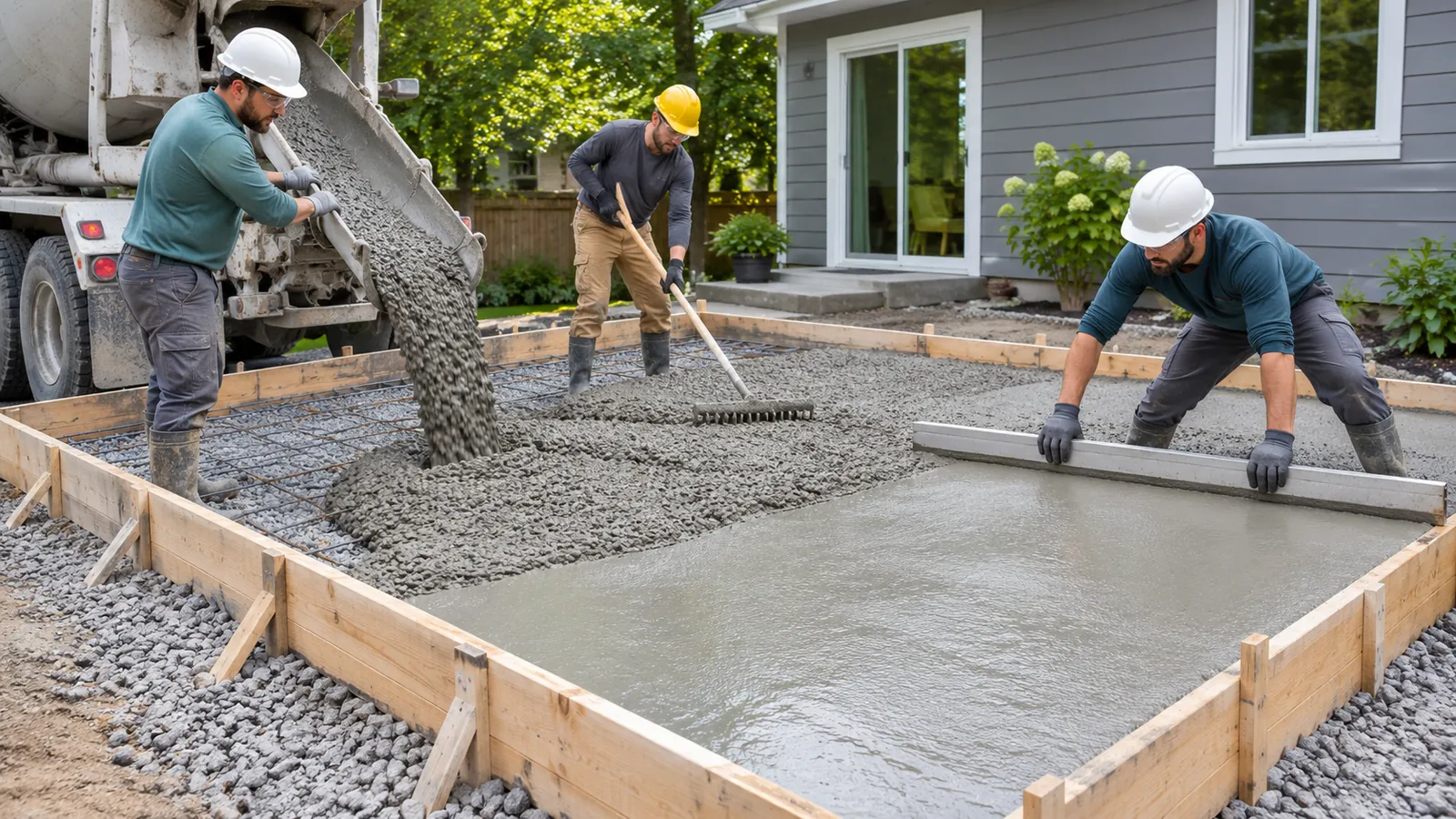
The two construction photographs are original AI-generated illustrations. The dimension diagram is original code-drawn artwork. Images do not document an inspected installation or replace project drawings.