Compound interest means earning interest on money you saved and on interest already added to it. Imagine leaving $1,000 untouched at an illustrative 5% annual rate. After one year you have $1,050. In the second year, interest is calculated on that larger balance, bringing it to $1,102.50.
That small extra amount is the beginning of compounding. Over longer periods, time and regular deposits can make a meaningful difference. This guide explains compound interest for beginners through examples you can follow, while keeping the assumptions, costs and risks visible.

Educational information, not personal financial advice. All examples use illustrative USD amounts and assumed rates, excluding taxes and fees unless stated. They do not recommend an account, investment or expected return.
What Is Compound Interest?
When interest is added to a balance and retained, future interest can be calculated on both the original money and those earlier earnings. The CFPB’s explanation of compound interest uses this relationship to show why the base for earning interest grows.
- Principal: the starting amount. Later deposits increase the money you have contributed.
- Interest: money credited under an account’s interest terms.
- Annual rate: the stated yearly rate; check whether it is a nominal rate or an effective yield.
- Compounding frequency: how often interest becomes part of the interest-earning base.
- Time: how long the money remains under those terms.
Compounding is a mathematical process, not a promise that a balance always rises. With market investments, people often say “compound growth” to describe reinvested returns. Those returns can include price changes and distributions, and they need not behave like fixed bank interest.
Simple Interest vs Compound Interest
Simple interest in this comparison is calculated only on the original principal: the same $1,000 earns $50 each year at 5%. With annual compounding at the same assumed rate, previous interest stays in the account and earns more interest. No deposits or withdrawals are included.
The conceptual distinction is also explained by ASIC Moneysmart’s compound interest guide. The artwork below is illustrative; the chart and tables use calculated values.
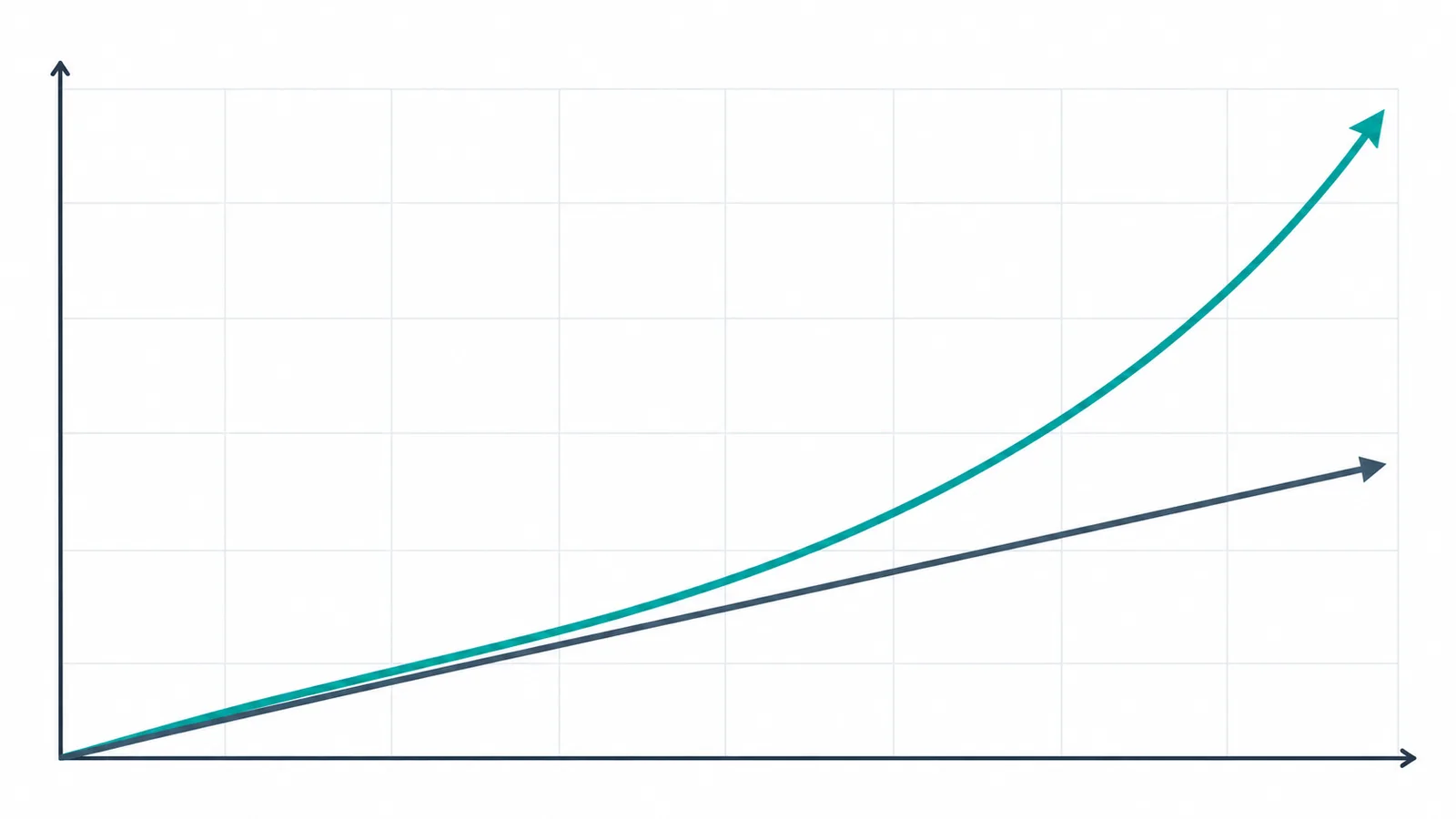
| Time | Simple-interest balance | Annual-compound balance |
|---|---|---|
| Year 0 | $1,000.00 | $1,000.00 |
| Year 5 | $1,250.00 | $1,276.28 |
| Year 10 | $1,500.00 | $1,628.89 |
| Year 20 | $2,000.00 | $2,653.30 |
View all 21 yearly chart values
| Year | Simple interest | Annual compounding |
|---|---|---|
| 0 | $1,000.00 | $1,000.00 |
| 1 | $1,050.00 | $1,050.00 |
| 2 | $1,100.00 | $1,102.50 |
| 3 | $1,150.00 | $1,157.63 |
| 4 | $1,200.00 | $1,215.51 |
| 5 | $1,250.00 | $1,276.28 |
| 6 | $1,300.00 | $1,340.10 |
| 7 | $1,350.00 | $1,407.10 |
| 8 | $1,400.00 | $1,477.46 |
| 9 | $1,450.00 | $1,551.33 |
| 10 | $1,500.00 | $1,628.89 |
| 11 | $1,550.00 | $1,710.34 |
| 12 | $1,600.00 | $1,795.86 |
| 13 | $1,650.00 | $1,885.65 |
| 14 | $1,700.00 | $1,979.93 |
| 15 | $1,750.00 | $2,078.93 |
| 16 | $1,800.00 | $2,182.87 |
| 17 | $1,850.00 | $2,292.02 |
| 18 | $1,900.00 | $2,406.62 |
| 19 | $1,950.00 | $2,526.95 |
| 20 | $2,000.00 | $2,653.30 |
The gap widens because the compound balance earns interest on accumulated earnings. That comparison holds the starting principal, rate and time constant. It does not show what a variable-rate account or an investment portfolio will actually earn.
How Compounding Works Step by Step
Start with $1,000, assume a fixed 5% annual rate, and add interest once a year. Leave all interest in the account and add no new money.
- Year 1: $1,000 × 0.05 = $50 interest. The balance becomes $1,050.
- Year 2: $1,050 × 0.05 = $52.50 interest. The balance becomes $1,102.50.
- Later years: apply the same rate to the new, larger balance.
Notice that the second year’s interest includes $2.50 earned on the first year’s $50. It is not an extra deposit you made.
| Year | Interest added (displayed) | Closing balance |
|---|---|---|
| 1 | $50.00 | $1,050.00 |
| 2 | $52.50 | $1,102.50 |
| 3 | $55.13 | $1,157.63 |
| 4 | $57.88 | $1,215.51 |
| 5 | $60.77 | $1,276.28 |
After five years, the projected balance is $1,276.28, including $276.28 above the starting amount. Calculations retain unrounded balances internally. Displayed interest reconciles the rounded closing balances, so rounding can shift a cent between rows. A bank’s actual crediting and rounding rules may differ.
The Compound Interest Formula
For one fixed principal, a constant nominal annual rate and regular compounding periods:
A = P(1 + r/n)nt
- A: final balance, including principal.
- P: initial principal.
- r: nominal annual interest rate as a decimal; 5% means 0.05.
- n: compounding periods per year; monthly means 12.
- t: time in years, expressed consistently with the annual rate.
For the five-year annual example, A = 1,000 × (1 + 0.05)5. Interest earned is A minus P. The expression assumes no additional deposits, withdrawals, taxes or fees, and no rate changes.
Regular contributions require an extended calculation. Each deposit has its own time to grow. Adding every future deposit to P at the beginning incorrectly treats money you will save later as if it had been earning interest from day one. Use the Compound Interest Calculator to model contributions and compounding frequency.
Why Starting Early Matters
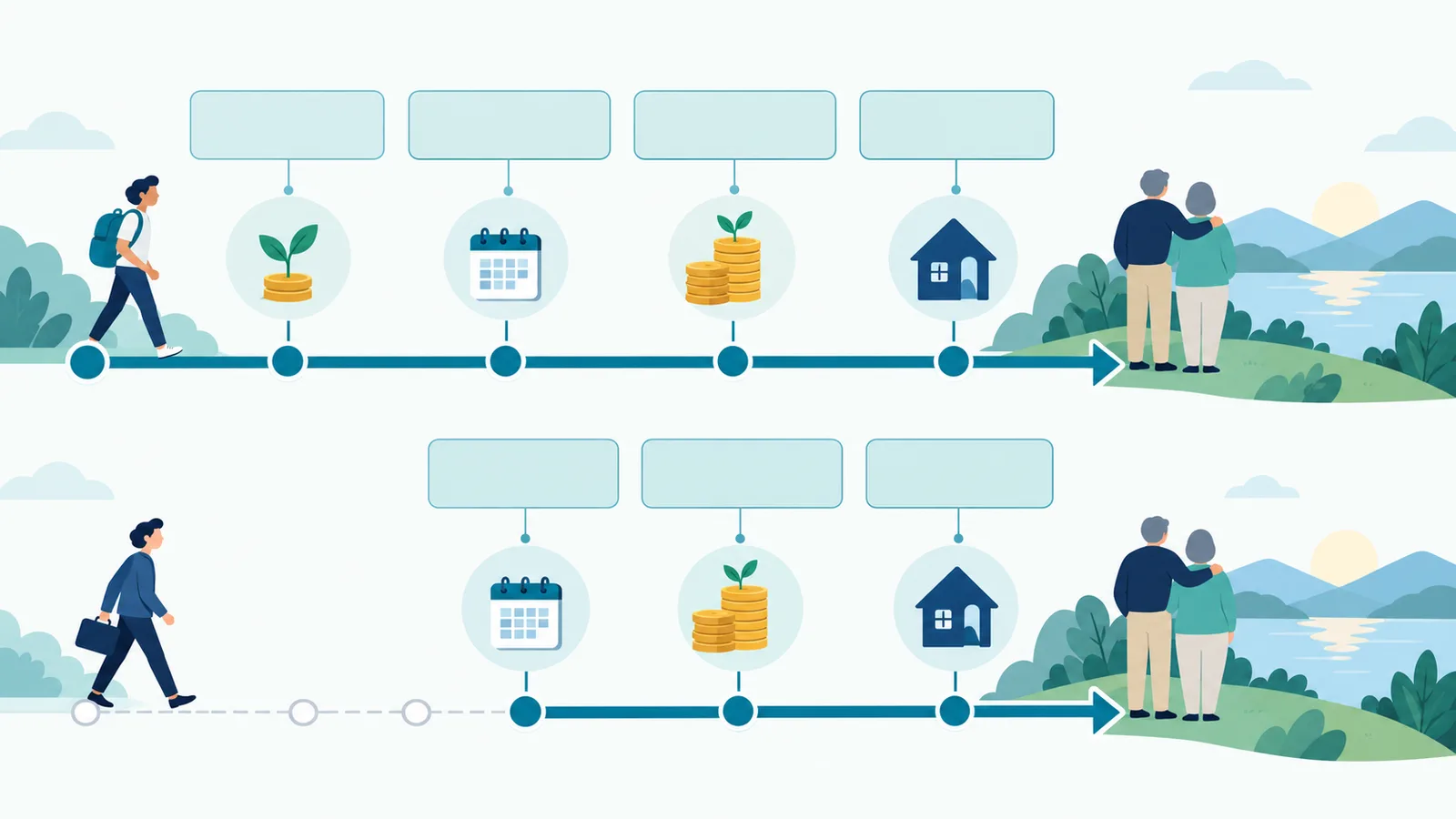
Consider two hypothetical savers who start from zero and save $100 at the end of every month until age 65. One begins at 25; the other begins at 35. Both use an assumed 5% nominal annual rate compounded monthly, with no withdrawals, fees or taxes.
| Starting age | Saving years | Total deposited | Modeled growth | Balance at 65 |
|---|---|---|---|---|
| 25 | 40 | $48,000.00 | $104,602.02 | $152,602.02 |
| 35 | 30 | $36,000.00 | $47,225.86 | $83,225.86 |
The earlier saver finishes with more because of both additional deposits and more time for growth. They contribute $48,000 rather than $36,000. It would be misleading to attribute the whole difference to compounding alone.
To isolate time, compare one $1,000 deposit left for 40 years with the same deposit left for 30 years. At an assumed 5% compounded annually, the respective balances are $7,039.99 and $4,321.94. Here, the principal is identical and neither saver adds more.
Singapore’s MoneySense explains the role of earlier, consistent saving. Starting earlier creates an opportunity, not a guaranteed outcome. If you are beginning later or can save only a small amount, these examples are a way to understand assumptions, not a verdict on your progress.
Monthly Contributions and Compounding Frequency
Deposit frequency and compounding frequency describe different things. You might add money monthly while an account calculates or credits interest on another schedule. Read the terms rather than assuming the two schedules match.
With the same $1,000 principal and 5% nominal annual rate over five years, annual compounding gives $1,276.28; monthly compounding gives $1,283.36. More frequent compounding helps in this comparison because the nominal rate is held constant.
At that nominal rate, monthly compounding produces an effective annual yield of about 5.12%. If two accounts already quote the same effective annual yield under comparable conditions, do not add a second “compounding bonus” to that yield.
Timing also matters. Starting from zero and depositing $100 monthly for a year at the assumed 5% nominal rate, compounded monthly, gives $1,227.89 for end-of-month deposits and $1,233.00 for beginning-of-month deposits. The latter deposits each receive one additional modeled monthly interest period.
These projections use equal model periods and unrounded accrual. Actual dates, minimum balances and crediting rules can change the result. The SEC’s compound interest calculator similarly asks users to specify assumptions rather than treating a rate as a forecast.
The Rule of 72
The Rule of 72 is a mental shortcut: approximate doubling years = 72 ÷ annual percentage rate. Use the percentage number, not its decimal form. At an illustrative 6%, 72 ÷ 6 suggests about 12 years.
Check the approximation: $1,000 growing at 6% compounded annually becomes $2,012.20 after 12 years, slightly above $2,000. The shortcut is close in that example, not exact.
Investor.gov introduces the Rule of 72 alongside compound interest. Its usefulness depends on the rate and compounding convention. It does not account for contributions, fees, taxes, inflation or unpredictable market returns, and it is not a doubling guarantee.
Inflation, Taxes, Fees and Investment Risk
Nominal balances and purchasing power
A larger money balance does not automatically mean the same increase in what it can buy. The Bureau of Labor Statistics explains nominal amounts and inflation-adjusted purchasing power. With assumed annual inflation of 2%, the five-year $1,276.28 balance has purchasing power equivalent to about $1,155.97 at the starting date.
For constant annual assumptions, the real growth rate is (1 + nominal rate) ÷ (1 + inflation rate) − 1. With 5% growth and 2% inflation, that is about 2.94% yearly. Neither assumed rate is a claim about current conditions.
Costs and local tax rules
Fees can reduce the balance that remains invested, affecting later growth as well as today’s value. The SEC’s investor bulletin on fees and expenses explains why recurring charges deserve attention. Flat fees and percentage fees behave differently; a single lower-rate estimate cannot represent every fee schedule.
Taxes depend on your country, account, income type and when gains or interest become taxable. A tax charged during the saving period can reduce what is available to reinvest. These examples are before tax and cannot establish an after-tax outcome for you.
Fixed interest and investment returns are different
A fixed bank interest rate applies for the period and conditions specified in its contract; a variable rate can change. Check the institution, withdrawal restrictions and any applicable local deposit-protection scheme. Protection limits and eligibility vary by jurisdiction and do not remove inflation risk.
Market investments can decline. Investor.gov’s explanation of stock risks distinguishes possible returns from money you can count on. A constant-rate projection smooths away real fluctuations. For example, $100 gaining 10% and then losing 10% ends at $99.00, not $100. An average of two percentage returns does not fully describe compound growth.
How to Build a Long-Term Saving Habit
Compounding becomes useful when it supports a plan you can maintain. Begin with a goal and a realistic view of cash flow rather than a return you hope to earn.
- Define the purpose and timing. Separate a near-term expense from a goal many years away. Money needed soon has different access and risk requirements.
- Consider emergency reserves. The CFPB’s emergency-fund guide explains why accessible savings can help absorb unexpected costs. The appropriate amount depends on circumstances; there is no required balance in this article.
- Choose a manageable contribution. Regular saving can be small and adjustable. Avoid setting a transfer so high that it causes missed essentials or account fees.
- Review the routine. The Financial Consumer Agency of Canada’s savings guidance discusses regular contributions and occasional extra deposits. Automation can help when it fits cash flow.
- Reassess assumptions. Check rates, charges, access needs and progress when circumstances change. Consider more than one growth scenario.
The Savings Goal Calculator can estimate a monthly contribution for a goal. A projection helps compare choices; it does not make an unaffordable contribution sustainable.
Common Compound Interest Mistakes
- Confusing APY, APR and a nominal rate. U.S. deposit APY reflects compounding under disclosure rules; APR commonly describes borrowing costs and is not interchangeable with APY. Definitions vary by product and jurisdiction. Read the CFPB’s APY calculation rules for the U.S. context.
- Assuming all returns are guaranteed. A modeled percentage is an input. It is not a commitment from a bank or investment provider.
- Ignoring costs. Compare charges, taxes and purchasing power alongside the headline balance.
- Modeling deposits you will not consistently make. A forecast based on uninterrupted contributions changes if contributions pause or money is withdrawn.
- Overestimating future growth. A high constant rate can create an impressive curve while hiding uncertainty. Explore lower assumptions too.
- Counting deposits as investment earnings. Separate the money you contributed from modeled interest or returns when evaluating growth.
Frequently Asked Questions
Can I benefit from compounding with a small starting amount?
Yes, interest can compound on a small balance when the account’s terms allow it. The outcome depends on the rate, time, deposits and charges. A fixed fee can matter more relative to a small balance, so read the terms.
Does monthly compounding always beat annual compounding?
It produces more growth when the same positive nominal annual rate and other assumptions are held constant. When comparing quoted effective annual yields, compounding is already reflected. Compare equivalent measures.
Is compound interest the same as regular saving?
No. Saving adds your own money. Compounding describes growth on retained earnings. Both can affect a final balance, but only the latter is earnings on earlier earnings.
Can compound interest also increase debt?
Yes, interest added to an unpaid balance may itself attract interest under the agreement. Borrowing costs can work against you. Loan and credit-card terms differ, so do not apply a savings example to a debt without checking its rules.
What happens if I withdraw the interest?
That withdrawn interest no longer earns future interest in the account. If the original principal remains, it can still earn under the account’s terms, but growth differs from the fully reinvested examples.
What if the return is zero?
With no growth, fees or withdrawals, the balance equals the initial money plus deposits. Contributions still matter even when a projection has no interest earnings.
Is it too late if I did not start young?
A later start gives less time under the same assumptions, but it does not make saving pointless. Goals, contributions, access needs and circumstances all matter. Use the comparison to understand trade-offs rather than to judge your past choices.
Explore Your Assumptions With CalcVibes
The power of compound interest comes from retaining earnings and allowing time for growth. Regular saving adds another important ingredient. Keep contributions, earnings and purchasing power separate, and remember that actual returns and costs can differ from a model.
Try a few assumptions with the tools below. The Savings Calculator opens the existing savings-growth mode; the Compound Interest Calculator also offers an optional inflation-adjusted projection. The standalone Inflation Calculator is still planned.
Sources and Calculation Notes
Sources checked on 28 October 2026. Calculation examples use the existing CalcVibes compound-interest engine, checked against independent formulas and iterative calculations. The annual table reconciles rounded balances; other outputs display unrounded calculations rounded to cents. The three original images are conceptual illustrations, and the chart uses verified numerical data.
- SEC Investor.gov: Compound Interest Calculator and its assumptions
- SEC Investor.gov: What is compound interest?
- CFPB: How does compound interest work?
- ASIC Moneysmart: Compound interest
- Singapore MoneySense: Effects of compounding interest
- CFPB Regulation DD: Annual percentage yield calculation (United States)
- SEC Investor.gov: How fees and expenses affect your investment portfolio
- U.S. Bureau of Labor Statistics: Income, CPI and purchasing power
- SEC Investor.gov: Stocks, returns and risks
- CFPB: An essential guide to building an emergency fund
- Financial Consumer Agency of Canada: Building a saving habit and emergency fund
CalcVibes publishes this guide for financial education. It does not claim professional investment review, provide individual investment advice or promise future returns. Local account, tax and protection rules should be checked separately.