Electricity bills change when you use more energy, your tariff changes, the billing period gets longer, or adjustments appear on your account. A higher payment does not automatically mean an appliance is faulty. Understanding electricity bills starts with separating how much electricity you used from what you paid for it.
This guide shows you how to read an electricity bill, explain kWh and charges, estimate appliance costs, and choose realistic ways to reduce electricity usage at home. Keep your latest statement nearby and compare it with an earlier bill as you read.
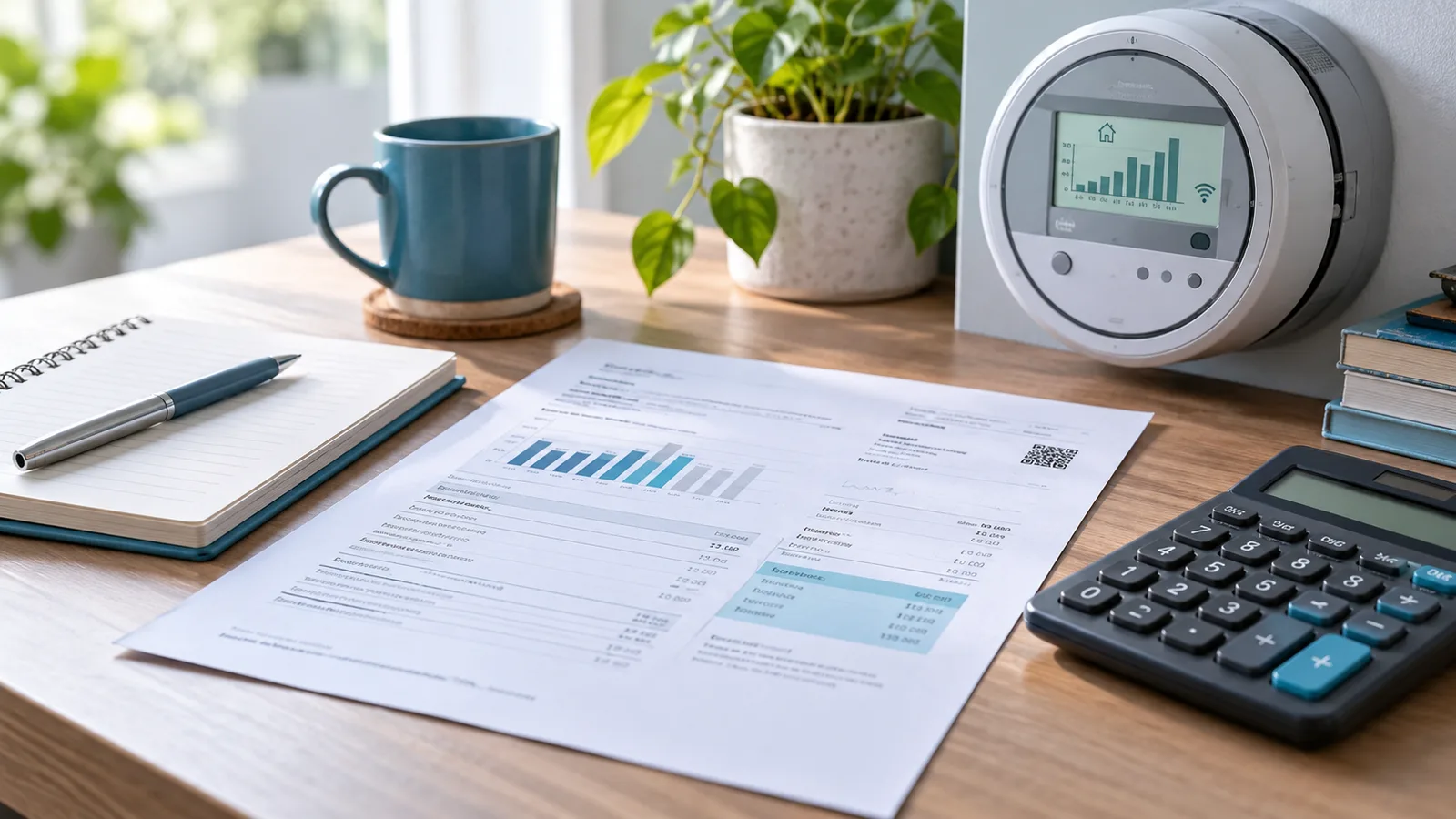
How an electricity bill works
A bill connects a period of service with recorded or estimated consumption and a set of charges. Start with these fields:
- Account and meter: check the service address and meter number, particularly after moving home.
- Billing dates: find the start, end and number of billed days. The payment due date is different.
- Meter readings: look for previous and current readings, and whether they are actual, customer-submitted or estimated.
- Consumption: locate the kWh used during that period. Multi-rate meters can have separate registers.
- Charges and balance: separate this period’s electricity charges from earlier debt, payments and credits.
For a straightforward cumulative kWh meter with a multiplier of 1, a current reading of 12,880 minus a previous reading of 12,480 means 400 kWh. Use any multiplier printed on your bill. Solar import/export registers, replaced meters and separate peak registers need their own treatment.
A regular bank payment may be a budget instalment rather than the exact cost of that month’s consumption. For an example of the distinction between tariffs, charges and payments, see Ofgem’s explanation of how an energy bill is calculated.
Understanding every charge on your bill
An electricity tariff is the pricing arrangement for your supply. These labels are common, but their names, availability and calculation rules differ by country and provider:
- Energy charge: the charge for kWh consumed. Some bills split generation, delivery and other usage-based components.
- Fixed or supply fee: a daily or monthly connection/service charge that can remain even when usage is zero.
- Taxes and levies: government charges, sometimes already included in advertised rates. Check before adding them again.
- Fuel or other adjustments: separate credits or charges under the applicable tariff. They can change independently of your consumption.
- Tiered rates: different prices for usage blocks. Confirm the block boundaries and whether thresholds depend on billing days.
- Peak/off-peak rates: different prices at different times. The exact schedule, seasons and meter requirements belong to your plan.
- Demand charge, where applicable: a charge based on measured demand in kW under a defined interval and pricing rule, separate from total kWh.
The North Carolina Public Staff’s bill guide explains energy charges and adjustment riders in its U.S. setting. In Great Britain, Ofgem publishes regional unit rates and standing charges; location, payment method and meter arrangements matter. In Australia, Energy Made Easy explains single-rate, time-of-use, controlled-load and demand tariffs. None describes a worldwide standard.
In a purely illustrative block tariff, the first 100 kWh might cost $0.15 each and the next 50 cost $0.25 each: $15 + $12.50 = $27.50. Do not automatically price all 150 kWh at the last block’s rate. Confirm how your own provider applies its tiers, discounts and eligibility rules.
Watts, kilowatts and kilowatt-hours
Watts (W) measure power: how quickly a device uses energy at a particular moment. A kilowatt (kW) is 1,000 W. Kilowatt-hours (kWh) measure energy: power accumulated over time. The EIA’s electricity measurement guide explains this distinction.
A device drawing a constant 1 kW for one hour uses 1 kWh. A 500 W device drawing that power for two hours also uses 1 kWh. This is the kWh meaning that matters on your bill: duration counts alongside power.
Do not confuse an air conditioner’s cooling capacity with its electrical input. Likewise, a motor’s maximum label rating is not necessarily its normal draw. For current and voltage questions, our Watts to Amps Calculator explains electrical power relationships; it does not estimate a utility bill.
How to estimate appliance electricity use
For a known constant or average power draw, use:
Energy (kWh) = watts × hours ÷ 1,000
Energy cost = kWh × applicable price per kWh
A 1,500 W appliance running continuously for 2 hours uses 1,500 × 2 ÷ 1,000 = 3 kWh. At an illustrative USD $0.20 per kWh, the energy charge is 3 × $0.20 = $0.60, before taxes, fixed fees or other charges.
If that same draw occurs for two hours every day for 30 days, it uses 90 kWh and costs $18 in energy charges at that assumed rate. A thermostat-controlled heater may cycle off, so two hours switched on is not always two hours drawing its full rated power.
For variable appliances, measure kWh over a representative period with a suitable plug-in energy monitor, use reliable device telemetry, or consult the energy label. Use appropriately rated monitoring equipment; a plug-in monitor is not suitable for every circuit or hardwired appliance. If a label gives annual kWh, divide by 365 for a rough daily estimate, recognising that test conditions may differ from your home.
To estimate your electricity cost per unit, first read the tariff’s usage rates. Dividing current-period electricity charges by kWh gives an effective average cost, which may include fixed fees. It is useful for comparing total bills, but it is not necessarily the amount saved by avoiding one more kWh.
Which appliances tend to use the most electricity?
Start with equipment that heats, cools or runs for many hours. The EIA’s U.S. household electricity overview identifies air conditioning, space heating and water heating as major categories in its survey data. Your household’s ranking depends on climate, fuels, occupancy and equipment: gas heating, for example, changes the electricity picture.
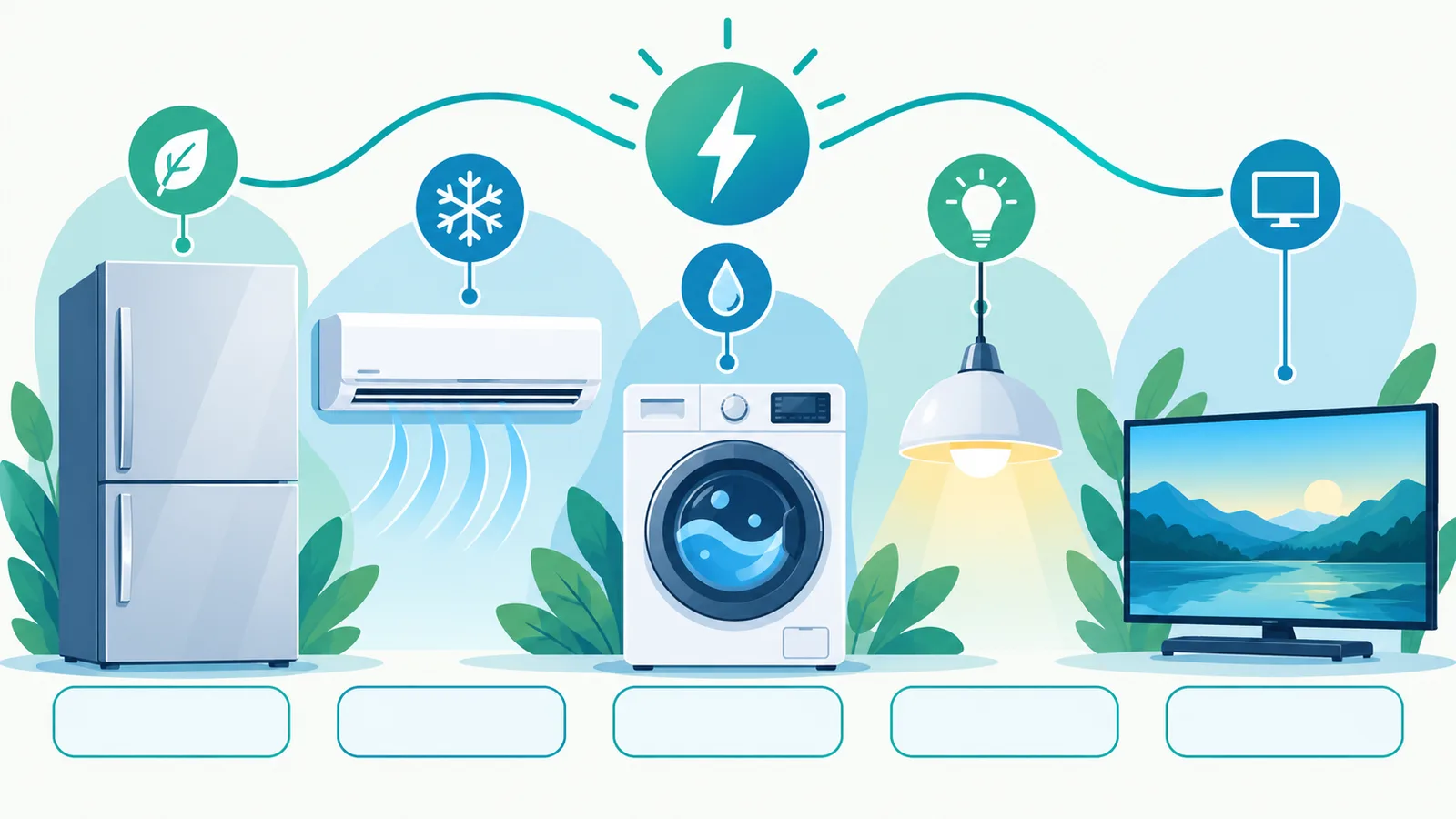
Hypothetical inputs for a 30-day month, not standard wattages or measured household averages. Costs use USD $0.20/kWh, excluding fees and taxes. Scroll the table horizontally if needed.
| Appliance | Assumed use | Monthly kWh | Energy cost |
|---|---|---|---|
| Air conditioner | 1,000 W average × 6 h/day | 180 | $36.00 |
| Portable heater | 1,500 W continuous × 2 h/day | 90 | $18.00 |
| Refrigerator | Assumed label: 365 kWh/year; 30/365 share | 30 | $6.00 |
| Television | 80 W × 4 h/day | 9.6 | $1.92 |
| Washing machine | 0.6 kWh/cycle × 12 cycles | 7.2 | $1.44 |
| Five LED lamps | 5 × 9 W × 5 h/day | 6.75 | $1.35 |
The refrigerator figure already allows for operation across the day through its assumed annual energy total. Multiplying its compressor’s label watts by 24 hours would be a different, often misleading assumption. Washer cycle energy varies with programme and water heating; the example excludes a separate dryer.
This list is not a complete home. Cooking, water heating, pumps, computers, vehicle charging and other loads may account for a large remaining share.
Why is my electricity bill suddenly so high?
Work through the bill before blaming a meter. Ask which of these changed:
- Season or weather: hotter or colder conditions can increase heating and cooling runtime.
- Billing period: 330 kWh over 33 days and 300 kWh over 30 days both equal 10 kWh/day.
- Prices or plan: a new rate, expired discount, adjustment or different peak-time mix can raise charges without raising kWh.
- Household routine: guests, working from home, a new heater, extra laundry or vehicle charging add loads.
- Equipment condition: changed thermostat settings or poorly maintained heating/cooling equipment deserve investigation.
- Reading correction: an actual reading after low estimates can produce a catch-up bill.
Compare daily usage with the same season last year, noting occupancy changes. If a discrepancy remains, photograph the accessible meter display, record the date, and ask your supplier to explain the reading, multiplier and tariff. Confirm the meter number belongs to your home. Let the supplier arrange any meter investigation; do not open or alter metering equipment.
Practical ways to reduce your electricity bill

Quick wins with little or no spending
Match heating and cooling schedules to occupancy while maintaining safe, comfortable temperatures. Use shading when sunlight adds unwanted heat, and keep doors or windows closed when conditioned air would escape. Clean or replace accessible filters according to the manufacturer’s instructions. The DOE Home Energy Checklist covers lighting, controls, maintenance and recurring checks.
Replace frequently used inefficient lamps with suitable LEDs, choosing brightness in lumens rather than matching watts. Turn lights off in empty rooms. Use appliance eco settings where appropriate, run sensible full loads, and avoid unnecessary tumble drying. The Energy Saving Trust’s household energy tips provide practical lighting and laundry guidance; its local savings estimates should not be applied worldwide.
Switch off unnecessary standby loads, or use a suitable switched power strip. DOE explains that some devices consume electricity while appearing off. Measure before assuming every charger is a major expense. Keep essential refrigeration, safety equipment and devices that require continuous operation powered.
Adjust schedules only when your tariff rewards it
On time-of-use plans, moving a flexible load to a cheaper window can reduce cost without reducing kWh. For example, shifting 10 kWh from an illustrative $0.30 rate to $0.15 saves $1.50. On a flat-rate plan, changing the clock time alone produces no energy-charge saving. Check appliance instructions before using delayed operation.
Longer-term improvements
Investigate air leakage and suitable insulation before buying larger heating or cooling equipment. ENERGY STAR’s sealing and insulating guide explains how to identify opportunities and work safely. Required ventilation and moisture control must be considered alongside insulation.
When replacement is justified, compare appliance energy labels, capacity and running cost alongside purchase price. A smaller efficient model that fits your needs may be preferable to an oversized one. ENERGY STAR’s home improvement guidance places heating, cooling, lighting and appliance upgrades in the context of a home assessment. Savings depend on your starting point; no single percentage applies to every home.
A step-by-step home energy audit
Turn observations into a short plan you can check next month:
- Gather a baseline: collect recent bills, preferably covering a year. Record days, kWh, reading type and current-period charges.
- Map the tariff: note all usage rates, fixed fees, time windows and any demand component.
- List major loads: identify heating, cooling, hot water and long-running equipment. Note which use electricity and which use other fuels.
- Measure representative use: use interval data or suitable monitors. Record hot days, visitors and unusual activities alongside readings.
- Walk through the home: look for avoidable lighting, standby loads, draughts and maintenance needs. Request a professional assessment for work beyond a safe visual check.
- Choose two actions: estimate their kWh impact and any installation cost. Start with a load you can actually control.
- Recheck fairly: compare daily usage over a similar period and consider weather. Keep changes that deliver useful results.
A worked monthly usage scenario
Suppose a fictional 30-day bill records 400 kWh. The six appliance scenarios above total 323.55 kWh; an assumed 76.45 kWh of other use brings the total to 400. This reconciles an example, not a model of a typical household.
At the assumed $0.20/kWh, energy charges are $80. Add an illustrative $9 fixed fee and $4 adjustment: $93 before taxes. Any applicable tax must follow the local rules. Past balances and credits would be reconciled separately to reach the amount due.
Reducing the example air conditioner’s average runtime by one hour per day, at the assumed 1 kW draw, saves 30 kWh over 30 days. Another hypothetical 15 kWh reduction brings total savings to 45 kWh, or $9 in energy charges. New usage would be 355 kWh. Fixed charges remain, while taxes and adjustments may behave differently.
A $90 improvement saving $9 each month has a simple payback of ten months under those assumptions. Seasonal use, maintenance and changing prices can alter that result. Use measured evidence before treating the estimate as a purchasing decision.
Common mistakes and misconceptions
- “Lower watts always means a lower bill.” Runtime matters: a 100 W device used for ten hours consumes the same 1 kWh as a 1,000 W device used for one hour.
- “A fixed tariff fixes my total bill.” A fixed rate can still produce changing bills when consumption changes. Check the contract.
- “Every kWh costs the average bill rate.” Fixed fees, tiers and time windows can make average and marginal costs different.
- “A smart meter saves energy automatically.” Data can help you identify changes; the meter alone does not reduce appliance use.
- “Solar generation equals zero charges.” Grid imports, fixed fees and export-credit rules still matter. Generation and billable imports are different quantities.
Frequently asked questions
What is 1 unit of electricity?
On many household electricity bills, one unit means 1 kWh: the energy used by a constant 1,000 W load over one hour. Verify the bill’s unit label, especially if a meter multiplier or another register is involved.
How many kWh does a home use?
There is no universal normal amount. Home size, climate, number of residents, heating fuel, hot water and vehicle charging all matter. Compare your own kWh per day across similar seasons before using a national average as a benchmark.
How do I estimate cost per kWh?
Read the tariff for the applicable usage rate or rates. To calculate an effective average, divide this period’s electricity charges by its kWh, excluding previous balances and unrelated charges. State whether taxes and fixed fees are included. The result is not automatically your marginal saving.
Do unplugged devices use electricity?
A device physically disconnected from all external power sources draws no electricity from your home’s supply. A battery may still discharge internally. A plugged-in device that appears off is different: it may draw standby power. Turning a television off with its remote does not necessarily disconnect it.
Why do electricity tariffs vary?
Generation and network costs, regulation, taxes, subsidies, location and contract design affect prices. Even within one country, regions and payment methods can differ. Use your current supplier’s tariff and your actual usage pattern when comparing plans.
Your next steps toward a clearer, lower bill
Check your readings and billed days, separate usage charges from other items, and identify the largest controllable load. Choose two changes, record the starting kWh per day, and compare a similar period after making them. Small measured improvements give you a better plan than guesses about individual appliances.
To compare your before-and-after figures, calculate the percentage reduction in electricity use. For example, 400 down to 355 kWh is an 11.25% reduction in energy use; the percentage reduction in your total bill can be smaller because of fixed fees.
Related electricity calculators
- Watts to Amps Calculator
Convert watts to amps or amps to watts for DC, single-phase AC, and balanced three-phase AC.
- Percentage Calculator
Calculate percentages, increases, and decreases.
Estimate a household electricity bill from usage, tariff rates and additional charges.
Estimate appliance electricity consumption from power draw and operating time.
Estimate electricity costs from kWh and the applicable price per unit.
Convert watts and operating hours into kilowatt-hours of electricity use.
Sources and references
Sources checked on 28 October 2026. Prices and numerical appliance scenarios in this article are illustrative calculations. Regional guidance applies to its stated market. The DOE electricity-billing resource is aimed at industrial facilities and is included for billing context; household recommendations draw on the home-focused sources below.
- DOE: Understanding Your Electricity Bills (industrial billing context)
- DOE: Home Energy Checklist
- EIA: Measuring electricity
- EIA: Electricity use in homes
- North Carolina Public Staff: Understanding Your Electric Bill
- Ofgem: How your electricity or gas bill is calculated
- Ofgem: Regional unit rates and standing charges
- Australian Energy Regulator, Energy Made Easy: Electricity tariffs
- DOE: Measuring Standby Power
- ENERGY STAR: Home Energy Improvements
- ENERGY STAR: Guide to sealing and insulating
- Energy Saving Trust: Quick tips to save energy at home
All three visuals were created for this guide with AI image generation. The appliance table, formulas and written assumptions provide the numerical information.